Pages

Friday, March 03, 2006

Friends, someone needs your support, solidarity


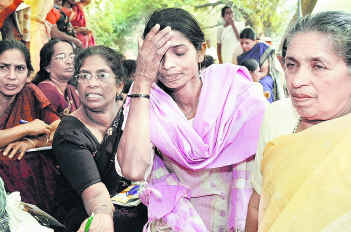
(TALES OF WOE Shiny Rajan from Wayanad district of Kerala narrates her woes outside the Kerala House in New Delhi on Saturday. Her husband had committed suicide as he was not able to repay loans. Photo: V V Krishnan/The Hindu/05 Mar 2006)
Dear Friends,

About seventy five women from north-Kerala have started an indefinite dharna in front of Kerala House from 2/03/06. All of them are demanding the state to write of their debts due to which their husbands had committed suicide. No way can they repay those massive debts.

Due to continuous harassment from the authorities these women have decided to take the battle to the state. They are of the opinion that they would not leave till their demands are met with.This struggle also brings to sharps relief the acute socio-economic crisis that have gripped the Kerala society.

What these women need is your valuable solidarity. If you can take time and visit the dharna site it would be tremendous boost to the resolve of these people.

In Solidarity,
Rona

FROM NEWSPAPERS/WEBSITES
NEW DELHI: "If you trouble me I will follow my husband to his grave and take my two children with me," 32-year-old Shiny Rajan told the village money lender — called "blade" locally — in Wyanad district of Kerala when he came calling for the nth time for the return of the loan taken by her farmer husband who had committed suicide. He had consumed the very pesticide he used to spray his banana plantation with, after the crop failed in the drought of 2002.

"I said it in sheer desperation because of the shame of not being able to cope," she told The Hindu here, tears welling up in her eyes. She parted with her small savings and eight sovereigns of gold but could not even clear the interest on the debt.

Shiny is one of the 53 farmers' widows and destitute farmer women who have come here from Wyanad district to knock at the door of the Central Government for relief and redress.
THE HINDU -- 05 MAR 2006
FULL TEXT


New Delhi: An angry Arundhati Roy, on Monday, put her voice behind a group of poor widows from Kerala who are in the capital to demand that they should not be asked to pay the loans taken by their dead farmer-husbands.

''I am very, very angry,'' said Roy after visiting the tent in front of the Kerala House where nearly 50 widows from the Wayanad district of Kerala are staging protests.

The author-activist saw the agitating widows when she was passing by the venue of their agitation, during the protests against the visit of US President George W. Bush last week.

''Bush was here for three days and I don't understand why the mainstream media is taking a holiday,'' she said apparently referring to the lack of coverage of the widows compared to acres of columns on the Bush visit.
FULL TEXT

New Delhi: Social activist Arundhati Roy Monday voiced her support to 53 women from Kerala's Wayanad district who were here seeking the government intervention to spare them the burden of clearing debts that drove their farmer husbands to suicide.

Even as Suresh Kurup of the Communist Party of India-Marxist from Kerala raised the matter in parliament, Booker Award winning author Roy said: "I share their concerns and support their causes."

Finance Minister P. Chidambaram, meanwhile, assured parliament that he would look into Kurup's demand to use the compensation of Rs.50,000 offered by the agriculture ministry to settle the loan owing and waiving the interest amount due.

"It should not be a problem," the finance minister told the house.

Agriculture Minister Sharad Pawar also promised to send a team to Wayanad district for a report into the conditions of farmers.

The loan amounts are, however, much larger than the government compensation package worked out so far, said Mary Mathai from Kalpatta, who faces the task of repaying Rs.85,000 to the Kottathara Cooperative Bank.
FULL TEXT

Laura, How About a Photo-op with Iraqi Children?


Statement of Bela Malik
Resident of 6/6 Jangpura B, New Delhi 10014

2 March 2006 -- The day Laura Bush visited Missionaries of Charity, Jangpura 'B' Delhi

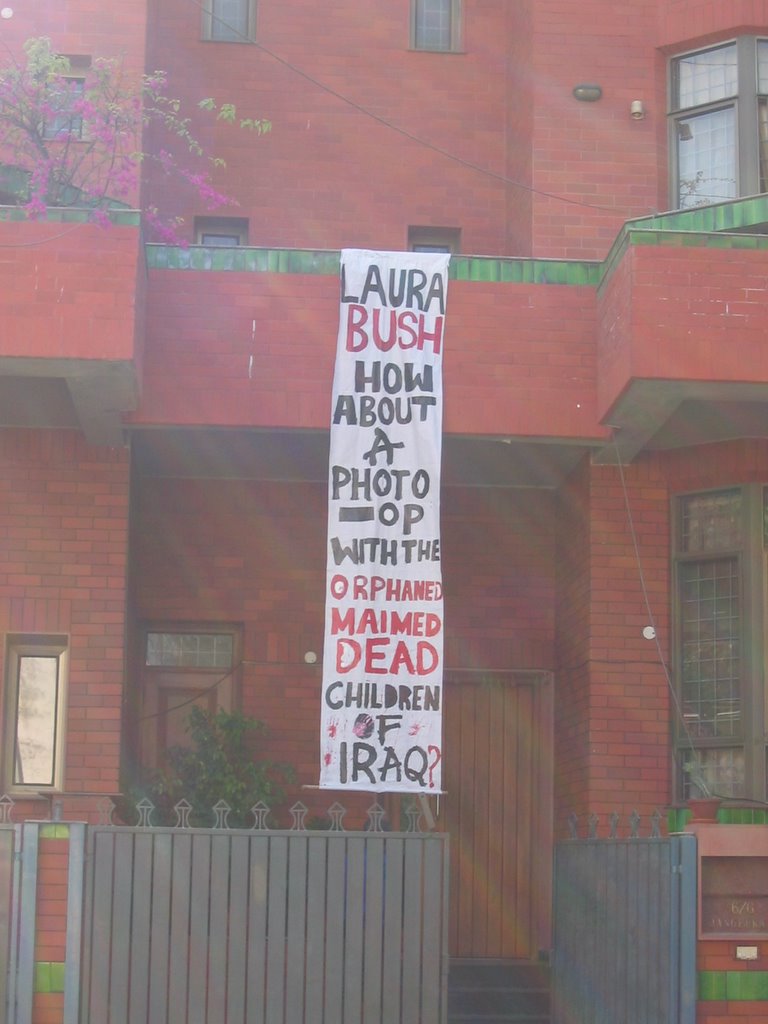
Today, Laura Bush, first lady, United States of America, visited Missionaries of Charity, Mother Teresa, an orphanage in Jangpura B, a building away from my residence. My friends and I had hung a white banner over the balcony of my flat, within private premises. The hand-made white banner read --
LAURA BUSH, HOW ABOUT A PHOTO-OP WITH THE ORPHANED, MAIMED, DEAD CHILDREN OF IRAQ?

The Delhi Police first asked my friends and me to remove the banner. We told them that legally we were within our rights to hang a banner in my residential premises.

The matter lay until half an hour before Laura Bush's motorcade arrived. The neighbourhood was over-run with US secret service agents, sniffer dogs, and all manner of US security, in addition to Delhi Police, CID, and other Indian security personnel, who were taking orders from the US personnel. At 3 p.m. Inspector, Delhi Police, Harsh Charan Varma, Delhi Police, SHO, Nizamuddin, said that he had to enter the premises for a routine check and that he would leave in a short while. The Delhi Police had already stationed a constable on the balcony of my house. The Inspector asked me not to shout any slogans. He personally removed every broken piece of tile from the balcony. We assured him that we did not want to shout any slogans, or hamper her visit in any way. We just wanted our banner to be displayed.

The Inspector came and ordered the constable and a sub-inspector who followed the Inspector to remove the banner.

We objected and said that this was a violation of individual rights because the banner was within my premises. They confiscated the banner. When my objection became more vocal, they became threatening and began to question the residents in my house with threatening body language, before finally leaving. The sub-inspector, however, remained stationed in the balcony of my house.

In a while, another banner was ready and put up which read,
What about Iraqi children?

We were allowed to put it up after Laura Bush left.

In our own country, in my own residence, I am denied the right to speak the truth in a peaceful, non-aggressive manner. A white banner was a security threat to the Bush establishment.

Residents were not allowed to leave their homes, or to arrive at their homes, during the period of her visit. A US security man was telling people not to go to their own homes, in their own country, in their own neighbourhood. The security had not given prior information to residents about their programme.

My friends and I wonder if we are living in a sovereign, independent republic of India? We also wondered what the Bush administration is so scared about.

Bela Malik
bela.malik@gmail.com

ALSO READ 'THE HINDU' REPORT

Jangpura bats for Iraq
Staff Reporter

NEW DELHI: The Delhi police confiscated a banner hanging over the balcony of a house close to Mother Teresa's Missionaries of Charity orphanage that U.S. First Lady Laura Bush visited on Thursday. Bela Malik, a resident of Jangpura, and her friends had hung a banner that read, 'Laura Bush, how about a photo-op with the orphaned, maimed, dead children of Iraq?'


"The police first asked my friends and me to remove the banner. We told them that legally we were within our rights to hang a banner at my residential premises," she said.

Well before Ms. Bush's motorcade arrived there, the neighbourhood was virtually taken over by U.S. secret service agents, sniffer dogs and Delhi Police personnel. "They were taking orders from the U.S. personnel," said Ms. Malik.

Around 3 p.m., the area Station House Officer entered Ms. Malik's residence on the pretext of a routine check. "A constable had already been stationed in the balcony of my house. The Inspector asked me not to shout any slogans. We assured him that we did not want to shout any slogans or hamper Ms. Bush's visit in any way. We just wanted our banner to be displayed," said Ms. Malik.

But the police officer allegedly ordered the constable and a sub-inspector to remove the banner, said Ms. Malik. "We objected and said that this was a violation of individual rights because the banner was within my premises. But they confiscated the banner. When we objected, they began questioning the occupants in a threatening manner. The sub-inspector remained stationed in the balcony."

"In our own country, in my own residence, I am denied the right to speak the truth in a peaceful, non-aggressive manner. A white banner was a security threat to the Bush establishment!" she said, adding that local residents were not allowed to leave their homes during the period of her visit.

Wednesday, February 15, 2006

The Death of Handwriting


Stuart Jeffries
Guardian

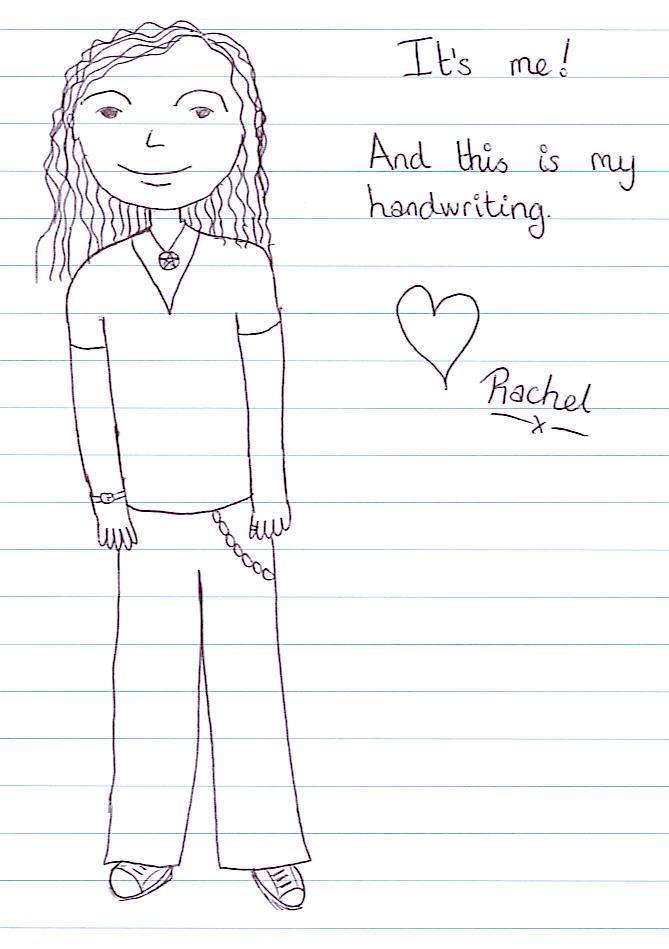
We spend our working days tapping into computers. We communicate with each other via email rather than letter. And today, as chip and pin technology becomes compulsory on the high street, even our signatures have become obsolete. Could it really all be over for handwriting?

...Yesterday afternoon I received a lovely letter from a correspondent that began: "Please forgive scribbled note. I can no longer type." But why, with all due respect, should anyone ask forgiveness when favouring me with the personal touch of their penmanship? When did typing become better than handwriting? (To which question an irritatingly good reply is: If you're so clever, why didn't you write this article by hand?)

Our very personalities seems to be slipping away when it comes to determining our identities. True, even signatures can be hellishly commodified (think of how Picasso's signature became the imprimatur of the boring Citroën people carrier), but they do at least remain distinctive to each of us, and an expression, whether we understand it or not, of some aspect of our character. As the website for the British Institute of Graphology says on its home page: "As a child you were taught to write. Why don't you continue to write the way you were taught?" The fact that you don't, it postulates, is the reason graphology exists.

Elaine Quigley, psychologist and chairwoman of the institute, says: "Pen and paper will always be necessary. Everything changes but I think writing will survive." She would say that, wouldn't she? Her discipline depends on people disclosing their personalities via handwriting... (FULL ARTICLE)

Monday, February 13, 2006

Why I Chose Journalism?


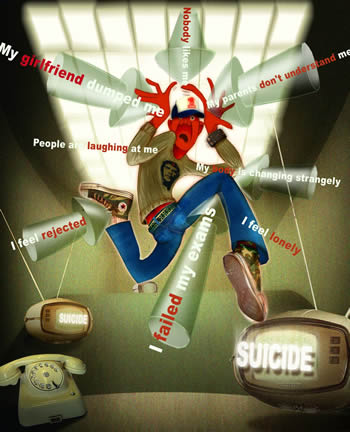
My firend Shivani, a journalist send me this SMS and I thought it was for this precise reason that I chose journalism.

I had many options --
- poison
- electrocution
- sleeping pills
- hanging by neck
- slashing wrist
- jumping from building
- coming under train
-
-
-
but I chose
JOURNALISM

Saturday, January 07, 2006

Press freedom in 2005


Reporters Without Borders Annual Roundup

(Released 4 January 2006)

In 2005
- 63 journalists and 5 media assistants were killed
- at least 807 journalists were arrested- 1,308 physically attacked or threatened
- and 1,006 media outlets censored

On 1 January 2006, 126 journalists and 70 cyber-dissidents were in jail around the world

In 2004… 53 journalists and 15 media assistants were killed… at least 907 journalists were arrested… at least 1,146 physically attacked or threatened … and 622 media outlets censored.

JOURNALISTS IN JAIL

CHINA: 32
CUBA: 24
ETHIOPIA: 17
ERITREA: 13
BURMA: 5

CYBER-DISSIDENTS IN PRISON
CHINA: 62
VIETNAM: 3
IRAN: 1
SYRIA: 1

FULL TEXT

THE HOOT

Thursday, January 05, 2006

Face to Face: Richard Stallman

Free Software as a Social Movement
Justin Podur interviews Richard Stallman

Richard Stallman is one of the founders of the Free Software Movement and lead developer of the GNU Operating System. His book is 'Free Software, Free Society'. I caught up with him by phone on December 1/05.

JP: Can you first of all explain the "Free Software Movement'.

RMS: The basic idea of the Free Software Movement is that the user of software deserves certain freedoms. There are four essential freedoms, which we label freedoms 0 through 3.
Freedom 0 is the freedom to run the software as you wish. Freedom 1 is the freedom to study and change the source code as you wish. Freedom 2 is the freedom to copy and distribute the software as you wish. And freedom 3 is the freedom to create and distribute modified versions as you wish. With these four freedoms, users have full control of their own computers, and can use their computers to cooperate in a community. Freedoms 0 and 2 directly benefit all users, since all users can exercise them. Freedoms 1 and 3, only programmers can directly exercise, but everyone benefits from them, because everyone can adopt (or not) the changes that programmers make. Thus, free software develops under the control of its users.

Non-free software, by contrast, keeps users divided and helpless. It is distributed in a social scheme designed to divide and subjugate. The developers of non-free software have power over their users, and they use this power to the detriment of users in various ways. It is common for non-free software to contain malicious features, features that exist not because the users want them, but because the developers want to force them on the users. The aim of the free software movement is to escape from non-free software.

JP: What was your history with the free software movement?

RMS: I launched the movement in 1983 with a deliberate decision to develop a complete world of free software. The idea is not just to produce a scattering of free programs that were nice to use. Rather, the idea is to systematically build free software so that one can escape completely from non-free software. Non-free software is basically antisocial, it subjugates it users, and it should not exist. So what I wanted was to create a community in which it does not exist. A community where we would escape from non-free software into freedom.

The first collection of programs you need in order to escape non-free software is an operating system. With an operating system, you can do a lot of things with your computer. Without an operating system, even if you have a lot of applications, you cannot do anything -- you cannot run them without an operating system. In 1983 all operating systems were proprietary. That meant that the first step you had to take in using a computer was to give up your freedom: they required users to sign a contract, a promise not to share, just to get an executable version that you couldn't look at or understand. In order to use your computer you had to sign something saying you would betray your community.

Thus, I needed to create a free operating system. It happened that operating system development was my field, so I was technically suited for the task. It was also the first job that had to be done.
The operating system we created was compatible with Unix, and was called GNU. GNU stands for "GNU is Not Unix", and the most important thing about GNU is that it is not Unix. Unix is a non-free operating system, and you are not allowed to make a free version of Unix. We developed a free system that is like Unix, but not Unix. We wrote all the parts of it from scratch.
In 1983, there were hundreds of components to the Unix operating system. We began the long process of replacing them one by one. Some of the components took a few days, others took a year or several.

By 1992, we had all of the essential components except one: the kernel. The kernel is one of the major essential components of the system. In GNU, we began developing a kernel in 1990. I chose the initial design based on a belief that it would be a quick design to implement. My choice backfired and it took much longer than I'd hoped. In 1992, the Linux kernel was liberated. It had been released in 1991, but on a non-free license. In 1992 the developer changed the license for the kernel, making it free. That meant we had a free operating system, which I call "GNU/Linux' or "GNU plus Linux'.

However, when this combination was made, the users got confused, and began to call the whole thing "Linux'. That is not very nice.

First of all, it isn't nice because there are thousands of people involved in the GNU project who deserve a share of the credit. We started the project, and did the biggest part of the work, so we deserve to get equal mention. (Some people believe that the kernel alone is more important than the rest of the operating system. This belief appears to result from an attempt to construct a justification for the "Linux" misnomer.)

But there is more at stake than just credit: the GNU Project was a campaign for freedom, and Linux was not. The developer of Linux had other motives, motives that were more personal. That does not diminish the value of his contribution. His motives were not bad. He developed the system in order to amuse himself and learn. Amusing oneself is good -- programming is great fun. Wanting to learn is also good. But Linux was not designed with the goal of liberating cyberspace, and the motives for Linux would not have given us the whole GNU/Linux system. tens of millions of users are using an operating system that was developed so they could have freedom -- but they don't know this, because they think the system is Linux and that it was developed by a student "just for fun'. (FULL TEXT)

Sunday, January 01, 2006

A New Year SOS from a Naga friend

Dear friends,
An interesting year-ender. As a journalist, I had the opportunity to read, edit and transmit year enders. But this one from one of my friends Lemyao was entirely different.
So this is my first post this year... Happy New Year
Shemin Joy

S.O.S
Lemyao Shimray


14th June 2005: The racial and communal discrimination towards people from different North East nationalities saw its heights when the fraternal organisations of the Hindu nationalist Rashtriya Swayamsevak Sang (RSS) called for uprising against "the vulgarity" as they said, "spread by Christian girls from North East in Delhi". The pamphlets were put up all across the campuses in Delhi. The translation read, "Christian girls belonging to the terrorist organisations of North East region roam around naked, and drunk late at night on the streets of Delhi. This is basically done to trap the men and then falsely accuse the men of rape in order to malign the image of Delhi and Delhi University…That, some Christian girls from Nagaland falsely accused some Bihari men of raping them in train."

One of the most serious social threats in Delhi is the increasing rape and molestation of women. The women from North East are targeted the most. When any case of woman from the North East is either raped, molested, or abused, the prejudice of the society in Delhi is such that the dress code and culture of different North East nationalities are blamed. Targeting people from North East is seen when the Kirori Mal College administration imposed a dress code only for North East students which was also publish in Times of India about his comment on it.(June 10, 2005).

22.June.2005: A letter was submitted by authorities of Delhi University to Naga Student justifying nothing to discriminate against any Gender , caste , region , religion were said regarding about the dress code for North East girl in Delhi University. And that the matter be treated as closed.

10. July.2005: A testimony from Manhoihkim "I was returning from Dwarka after Church service. When I reach Chirag, Delhi I was eve teased by a man, when I ignored he said something in Hindi and caught my hand. Then when I tried to resist he slapped me thrice on my face. I started walking away crying but he came to me again , caught me on my breast and slapped me repeatedly saying that he resides in Chirag and it is his area. He threatened me with life and modesty if I complain.
11. July.2005: In Hindustan times it was mention that on Sunday 3.30 pm a 24 years old North East girl along with her friend, while coming back to her rented room was misbehaved and molested by a Taxi service owner….and that, it is the third incident in the couple of months involving girls from North East.
13 Oct.2005: FIR was filed by North East girl A.Gunlu who stays in North Delhi hostel complaining against a person who physically assaulted and molested her while coming back from NSUD sports week.

12. Nov.2005: Two women and a man from Nagaland were attack by two young men.
15. Nov.2005: A Manipuri girl was molested by three youths in Nehru Vihar, Delhi. When the girl raise alarm, a crowd gathered but no one made any move to chastise the three men, who in turn raised voices and started threatening the victim before running away. The police were reluctant to file an FIR as the three youths were from the same locality which led to a mass protest by Manipur Student Association Delhi (MSAD).

17.Nov.2005: North East girl from Delhi University student was misbehaved by 20 years old youth when the girl had gone to the market accompanied by her brother and a friend which led to the protest from North East student.
18. Nov.2005: HINDU "Two young men have been arrested on charges of harassing a North East girl.

21. Nov.2005: TIMES OF INDIA "Two youth arrested on Sunday for allegedly assaulting North East woman on Saturday night. They beat up her cousin brother after he tried to intervene.

14. Dec.2005: A Manipuri woman in Gurgoan was almost dragged into truck on 12.Dec at 6.30pm. She manages to escape at the last minute. According to the police the woman was walking through main gate when a truck started following her. The driver offered a lift which she refused, but the truck continued to follow her as she walks into the colony of Sun City. After a while the truck driver and his cleaner started passing lewd remarks, forcing the woman to run into a narrow lane. Her pursuers got off from the vehicle and began chasing her and tried to drag her into the vehicle. The Manipuri women, however, manage to break free and run towards a nearby house. She rang the bell and sought refuge there. Said the investigating officer "neither the Sun City management nor the resident informed police and thus the investigation got delayed and the truck driver managed to flee and the guard could not chase them."

Now the situation has worsened and the women in Delhi are not safe at all even in broad daylight. The police are reluctant to work on it if it is to do with North East which gives more courage for the culprit, the public watch as a mere spectator if we defend ourselves and judge us as outcaste and uncivilised if we create scene while defending ourselves.
Such is the case when I broke a finger of an Indian man in a crowded bus when he grope and try to squeeze my buttock. When I threatened to gouge his eyes out next time I was left with a comfortable space in that crowded bus by the public inside with a clear message that there is one insane, uncivilised, wild North East girl among the well mannered ladies and gentlemen. No one judge him but they make a point to recognise me as an outcaste.
Most of the women who are the victims are either those working late as in call centre or showroom or student staying in rent. The mindset of the young generation in Delhi about North East is that we are too liberal in every way and that we should be more conservatives are lame excuses and have nothing to do with culture and upbringing. There are many Indians who wear only Salwar Kameez and still work as a call girl, many who don’t touch a drink but still give free sex! This outrage alarming gesture is a plain Gender, caste; region, religion and sexual discrimination which even the administrator are in hand encouraging the Indian youth.

It is an appeal to organisation from back home to at least take an immediate initiative to black out such mentality and for the safe guard of North East women in Delhi. The above mention incident are few that were spotted within half a year and many were left unreported and unspotted, which cannot und ermined as not serious. Support and initiative from back home is only the hope the NorthEast women can rely on this New Year for their safety.

KUKNALIM!!!!!