Pages

Friday, July 06, 2007

A free market for journalists!!!


Hammer and Tongs
ALOKE THAKORE

When companies decide that they agree not to hire from their competitors, it is clear that they are forming a cartel designed to suppress wages

A complaint often heard about journalists and how greedy they have become, especially the younger lot, comes in the form of: He took the offer letter from us and then showed it to his present employers and then took double the hike. How unethical. And then there is the other one who took our offer letter, showed it to her bosses, got a hike, came back to us and then asked for an even better offer. Presumably the listener is supposed to sympathize with the predicament of these senior journalists or the HR executives in the face of such practices.

Such complaints were heard when Divya Bhaskar was launched in Gujarat, when DNA was launched in Mumbai, and whenever there is talk of hiring good journalists. Presumably that is what the cricket coach did when he went back with the BCCI offer and negotiated his terms with Kent. Or at least that is what one newspaper reported.

But this is not about cricket and coaches. It is about the seeming horror of journalists at such a practice by their colleagues. Let us start with what is now the acknowledged position of most newspapers in their editorial pages and also in the way they run stories on the news pages: the belief and commitment to the idea that free markets are efficient in addressing economic problems and needs. One of things that those who write on the efficiency of markets talk about is the manner in which free markets, unfettered by government regulations and other coercive mechanisms, allow for the price discovery to take place. It is only in conditions of free market that the seller of a good or service is able to get the highest price that the buyer is able to afford. Since there will be numerous buyers and numerous sellers, so we are informed, the proper price will be found and given to the seller of the service. It is for this reason that reducing the number of buyers, or sellers, or collusion among buyers or among sellers is seen as being an impediment to the free market process. Such a primer would not be necessary were it not for the fact that journalists are apparently horrified at the prospect of journalists who have nothing better than their skills moving from buyer to buyer trying to command the right price. They are just trying to discover the price of their skills.

But what about ethics or double-crossing, or the like? It is certainly less unethical than companies who decide, for example, not to poach from each other. That to me is collusion. When companies, necessarily fewer in number and hence with the ability to both agree and enforce such agreements, decide that they agree not to hire from their competitors, whether it be in the news business or in any other business, it is clear that they are forming a cartel designed to suppress wages. It is analogous to the mandi where middlemen often keep the procurement price of a perishable commodity low by refusing to buy above a certain price.

One can understand the anxiety of those charged with profit and loss responsibility in news organizations or the human resource executives charged with getting competent candidates at racked down wages in moaning about the uppity journalist who is merely following the logic espoused in their newspapers and magazines. It is the journalist that one is surprised about and concerned.

Do these journalists not get it? If today they are bothered about junior journalists trying to find out what is the cost of their wares, it may well be that these senior journalists’ price is also likely to be depressed. After all, it does not take a lot of imagination to realize that if there is a problem with those lower down the rung finding their right price, so there would be with those higher in the hierarchy seeking a reasonably right recompense for their services.

But then again it may be not be a question of imagination. It may be simply a case of false consciousness. Marx has his uses. While the logic of free market is fine for the company, for the economy, for the country, it does not seem to be that there should be a free market for labour, which allows someone to get the highest price for her skills and services. If at all there should be any sympathy, it should be for those who cannot poach and get the right candidate and for those journalists stuck in such no-poaching markets, and any lack of formal recorded knowledge prohibits one from naming them, which do not allow them to command the wages they deserve.

Contact:
hammerntongs@fastmail.com

BORN IN CHAINS by Lemyao Shimray

After long time, I am back on the blogosphere... this time with my naga friend's Lemyao's piece.
Rgds
Shemin

BORN IN CHAINS
Lemyao Shimray

'My name is Thilaw
I am ten years old.
I go to school and I am in class – III.
The name of my school is Somra Government Junior High School.'

Smile

Those are the only common lines he and his school shares with other of the world. For him, the young boy's picture in his Social Studies book, combing hair, with smart school Uniform lives in another world. Thilaw have never seen school uniform in his life nor has he worn shoes to school.

His daily routine starts before the rooster goes for hip-hop atop the tree and ends after the owl hoots. He collects wood or work at fields for his teachers after school. He has to compete with time by kicking the early dust. With his meager lunch and books, a bit- too-tight-pants which clings to his narrow, undernourished body, slimy green snake-like fluid rubbed away from his shirt sleeve, Thilaw gets ready to face another 15 kilometer of journey by foot through the forest to attend school.

Gone is the buffoonery line- 'Early to bed and early to rise makes a man healthy, wealthy and strong'.


Unlike other good boys, Thilaw hates vacation because during vacation he was not allowed to play. He has to work for his teachers as a mode of payment in spite of the fees paid by his parents to the teachers. No one questions the forced labour because people like Thilaw are not supposed to ask such thing; they are destine to do it as a volunteer work. Yes! Ten years old boy performing manual labour for his teacher after school is a volunteer work inspite of the urge to play 'warlord' like in his English-I book.

No one questioned the force labour. Like Thilaw's parents, many other Burmese had accepted the law since 1962. Gen Ne Win's draconian era, where the wicked General believes in Force labour and military regime.

His says his books were brought by his parents from far-far away place and that they are very precious.

Another Irony of truth.

His parents like many parents who reside in Eastern Nagaland in a village known as Phungtiere. They have to make two days journey to a place known as Layshi (North of Burma) to collect books for their children. It's a constant struggle. The thirst to educate their children makes them seek schools in the bordering villages of neighbouring country. It was not easy task as it's a constant struggle from getting books to trying to hire teachers for an abandoned school. Children monthly mid day meals were cut off to feed the teachers, Village development schemes are deducted to pay teachers salary and above that they sacrifice their sons and daughters for THE forced labour.

In the end when their children gain education they were frisk away by junta army to get enroll in Army schools and college, where they have to work under Military regime.

Some how it's hard to sing – We don't need no EDUCATION.

This child seems to have forgotten what its like to be free. They seem to have no fear of the prowling earthlings in the forest. Thirst and quest for knowledge were implanted on them so strongly, without them knowing. Sleep and darkness, play and day...all were robbed gently without them noticing.

Come children, angels from earth!
Let me cradle you to sleep.
place you
on the lap of the thunder.
Hear its roar and be afraid for once
'cos'
i saw in you
the lost of horrors.


As the schoool bell rang, Thilaw closes his books. He walks silently with a beaming smile to greet the terrace field of the Somra forest. Down below he saw what he had been seeing always - Chains and human beings, bending down, working hard, forced to please their masters.

June, 2007
Somra Village
Eastern Nagaland.

Lemyao Shimray

Tuesday, May 02, 2006

Interesting Material...Read On


Friends, I got a mail from FRIENDS OF TIBET on 'The Hindu'. It made some interesting reading and raised some interesting points about journalsim --- Shemin/Rgds
Save The Hindu Campaign --- The Hindu, one of the most credible and trusted newspapers in the country has many things to its credit. Chief among them is the appointment of an Ombudsman or a Readers' Editor in a newspaper for the first time in the history of Indian journalism. This 127-year-old newspaper with 3.8 million readers has a different story to tell ever since N Ram, who describes himself as "An Indian who has no sympathy for the Dalai Lama's separatist and backward looking agenda", took charge as the editor-in-chief of the newspaper on July 1, 2003.

Friends of Tibet has learned that the editorial board of The Hindu led by N Ram has instructed their centres not to carry any 'Tibet', 'Dalai Lama' and 'Falun Gong' stories criticising the policies of the Chinese government. Instead of depending on reliable news agencies like PTI, UNI, IANS, Reuters, AP and AFP, The Hindu has found a Beijing-based news-agency to fetch stories - The Xinhua - world's biggest propaganda agency belonging to the Chinese Communist Party. Probably The Hindu is the only newspaper in the country to reproduce Xinhua reports. Today The Hindu has virtually become a mouthpiece of the Chinese Communist Party.
Perhaps unique in the world because of its role, size, and reach, Xinhua reports directly to the Chinese Communist Party's Propaganda Department and employs more than 10,000 people. The head of the Xinhua has the rank of a minister. Successor to the agency, Red China that was founded by Mao Zedong, Xinhua adopted its current name in January 1937. Since October 1949, this state-run news-agency has been completely subordinate to the Chinese Communist Party and remains the voice of the sole party.

A card-holding member of the Communist Party in India who had been to China and occupied-Tibet at least fifteen times in junkets mostly arranged by the Chinese Embassy in New Delhi, N Ram is also the mastermind behind 'India-China Association of Journalists', an embassy-sponsored organisation specialising in arranging pleasure trips for Indian journalists. This new strategy of Beijing has already won the hearts of some of our best journalists. Ironically it is only when the Tamil Nadu Police entered The Hindu office premises in Chennai, N Ram who calls the killing of a million Tibetans by China's occupying forces 'a myth', got enlightened about freedom.

We believe that it is immoral from the side of an Editor to drag some of the eminent journalists to do ethically-wrong reporting for The Hindu and Frontline and also to use a democratic forum - freedom of the press - to advance the cause of an autocratic regime.
'Save The Hindu' Campaign is an attempt to save the newspaper and also to expose Xinhua - Chinese government's propaganda agency to its readers. Let us use the opportunity to write to the newly-appointed Readers' Editor about our concerns on The Hindu policies on various issues including Tibet.
Source:
www.friendsoftibet.org/save/

Friday, March 24, 2006

Real Life Laws


LORENZ'S LAW OF MECHANICAL REPAIR
After your hands become coated with grease, your nose will begin toitch.

ANTHONY'S LAW OF WORKSHOP
Any tool, when dropped, will roll to the least accessible corner.

KOVAC'S CONUNDRUM
When you dial a wrong number, you never get an engaged one.

CANNON'S KARMIC LAW
If you tell the boss you were late for work because you had a flat tire,the next morning you will have a flat tire.

O'BRIEN'S VARIATION LAW
If you change queues, the one you have left will start to move fasterthan the one you are in now.

BELL'S THEOREM
When the body is immersed in water, the telephone rings.

RUBY'S PRINCIPLE OF CLOSE ENCOUNTERS
The probability of meeting someone you know increases when you are withsomeone you don't want to be seen with.

WILLOUGHBY'S LAW
When you try to prove to someone that a machine won't work, it will.

ZADRA'S LAW OF BIOMECHANICS
The severity of the itch is inversely proportional to the reach.

BREDA'S RULE
At any event, the people whose seats are furthest from the aisle arrivelast.

OWEN'S LAW
As soon as you sit down to a cup of hot coffee, your boss will ask youto do something which will last until the coffee is cold.]

HOWDEN'S LAW

You remember you have to mail a letter only when your'e near the mailbox.

(Courtesy: My friend who mailed me this)

India: One Country, Two Worlds


Girish Mishra
Two reports have appeared simultaneously. One report has been carried by the American magazine Forbes and the other by the German journal Der Spiegel’s English version. These two reports underline that India, despite being one country, is getting divided into two worlds, which may have disastrous consequences... It emerges from the perusal of the list that as many as 27 billionaires are from India, who include 10 new entrants. No other country barring the US has so many new billionaires...
In the case of India too, rise in stock market prices by 54 per cent over the year have thrown up so many new billionaires...
It needs to be noted that most of these new billionaires and millionaires from India are from the services sector. They have been dealing in information technology and financial services. Only a handful of them have anything to do with the production of goods...
The German newspaper Der Spiegel's report begins with the concrete case of Ramakrishna Murthy, who after working for 10 years as a food chemist has just been thrown out by his employer, Hindustan Lever, a subsidiary of the Anglo-Dutch multination, Unilever.
The company has told him that, at 52 years of age, he is “too old, too inflexible and too expensive” for it to afford him. Finding no alternative but to vacate his apartment he has moved to a long abandoned dilapidated house.
To quote the report, "Now he and his family are living without any kind of appreciable social safety net in an abandoned house that is falling apart on the edge of Bangalore. They struggle to make ends meet with his wife’s salary."
Murthy regards himself "as one the victims of the 'Indian economic wonder' and, as such, one of the 'losers of globalization' – those who have lost their jobs as a result of India’s economic liberalization."
(Article from www.zmag.org)

Sunday, March 05, 2006

Baby Bush Go Home


Arundhati Roy

On his triumphalist tour of this part of the world, where he hopes to wave imperiously at people he considers potential subjects, President Bush's itinerary is getting curiouser and curiouser. For his March 2 pit stop in New Delhi, the Indian government tried very hard to have him address our Parliament. A not inconsequential number of MPs threatened to heckle him, so Plan One was hastily shelved. Plan Two was that he address the masses from the ramparts of the magnificent Red Fort where the Indian prime minister traditionally delivers his Independence Day address. But the Red Fort, surrounded as it is by the predominantly Muslim population of Old Delhi, was considered a security nightmare. So now we're into Plan Three: President George Bush speaks from Purana Qila, the Old Fort.

Ironic, isn't it, that the only safe public space for a man who has recently been so enthusiastic about India's modernity should be a crumbling medieval fort?Since the Purana Qila also houses the Delhi zoo - George Bush's audience will be a few hundred caged animals and an approved list of caged human beings who in India go under the category of "eminent persons". They're mostly rich folk who live in our poor country like captive animals, incarcerated by their own wealth, locked and barred in their gilded cages, protecting themselves from the threat of the vulgar and unruly multitudes whom they have systematically dispossessed over the centuries.

So what's going to happen to George W Bush? Will the gorillas cheer him on? Will the gibbons curl their lips? Will the brow-antlered deer sneer? Will the chimps make rude noises? Will the owls hoot? Will the lions yawn and the giraffes bat their beautiful eyelashes? Will the crocs recognise a kindred soul? Will the quails give thanks that Bush isn't travelling with Dick Cheney, his hunting partner with the notoriously bad aim? Will the CEOs agree?

Oh, and on March 2 Bush will be taken to visit Gandhi's memorial in Rajghat. He's by no means the only war criminal who has been invited by the Indian government to lay flowers at Rajghat. (Only recently we had the Burmese dictator General Than Shwe, no shrinking violet himself.) But when George Bush places flowers on that famous slab of highly polished stone, millions of Indians will wince. It will be as though he has poured a pint of blood on the memory of Gandhi.

We really would prefer that he didn't.

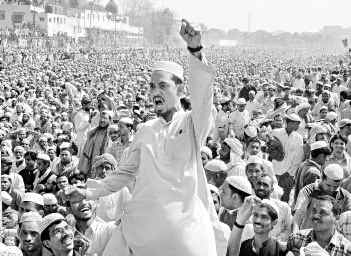
It is not in our power stop Bush's visit. It is in our power to protest it, and we will. The government, the police and the corporate press will do everything they can to minimise the extent of our outrage. Nothing the Happy-news Papers say can change the fact that all over India, from the biggest cities to the smallest villages, in public places and private homes, George W Bush, incumbent president of the United States of America, world nightmare incarnate, is just not welcome.

Bush in India: an email exchange with the BBC


Friends
This is an exchange of e-mails between Gabriele Zamparini and the BBC editors. See, for yourselves how Zamparini teaches us a little bit of journalism...read on...

--- Another BBC News website article reads:

Communist parties and Muslim groups are opposed to the visit and are leading protests across India, but Mr Bush is being welcomed by many other Indians. (Bush finalises India nuclear deal, BBC News Website, Thursday, 2 March 2006)

QUESTION: Could I ask you and Sanjeev Srivastava who are these “many Indians who will welcome him” ? This is more than a simple curiosity; since you reported the numbers, the place and political and religious affiliation of the protesters, I assume you will care to do the same with the Bush’s supporters.

Thank you for your time and I look forward for your comments.

Kind regards
Gabriele Zamparini


FULL TEXT OF THE e-mail EXCHANGES

THE CAT'S DREAM